
ARTIFICIAL "LIVING" INTELLIGENCE: AI, SENSORS AND BIOTECH AGENTS CREATING THE FUTURE OF COGNITIVE SYSTEMS

Artificial “Living” Intelligence: AI, Sensors and Biotech Agents Creating the Future of Cognitive Systems
Living Intelligence describes the emerging fusion of artificial intelligence, advanced sensing technologies, and biotechnology that is giving rise to a new class of adaptive, life-like cognitive systems. Unlike traditional AI, which operates on fixed algorithms and digital data, these systems are designed to sense, learn, and evolve continuously and cohesively; much like living organisms. They represent a shift from passive computing toward active, embodied intelligence that are intrinsically and cohesively trained to interact with both biological and environmental systems.
At the core of this concept is the interplay between three foundational technologies. Artificial intelligence provides the analytical and decision-making capacity, using real-time data to identify patterns and make adaptive choices. Sensors, particularly biosensors and nanosensors (pharmaceuticals), vaccines and engineered bacterium / viruses (pathogens) act as the multilayered sensory networks that are the synthetic agents responsible for collecting chemical, biological, and environmental signals from the world or even from inside the human body. Biotechnology enables these systems to directly influence or integrate with living matter, through genetic engineering, biointerfaces, and synthetic biology. Together, these components form closed feedback loops where sensors gather data, AI interprets it, and biotechnological elements enact changes which creates systems and pathways that learn and adjust autonomously.
The applications of living intelligence are wide-ranging. In healthcare, it underpins responsive implants, smart prosthetics, and biosensor-driven therapies that can modify treatment in real time. In agriculture and environmental monitoring, AI-linked biosensors and engineered organisms aka synthetic biology - alter soil, and effect wildlife, and manipulate crops to changing conditions. Smart cities and infrastructure may use similar principles to create buildings and energy systems that self-regulate based on human and environmental feedback. At the frontier, human–machine interfaces and neurotechnologies are bringing this convergence into the body itself, enabling new forms of augmentation and communication.
Living Intelligence has been fully implemented and deployed as a bio-digital ecosystems, where AI-driven networks continuously monitor, model, and influence the physical and biological world. This convergence has redefined what we consider to be “intelligent life,” and is transforming medicine, environmental management, and human identity itself. In essence, Living Intelligence envisions a future where intelligence is no longer confined to machine or code - it becomes distributed across living systems, blending biology, data and cognition into a single adaptive fabric.
Living Intelligence: AI, Sensors, and Biotech Creating the Future of Cognitive Systems
We are entering a time where machines are no longer limited to fixed commands. They are beginning to sense, learn, and respond like living beings. This change is due to the growing connection between Artificial Intelligence (AI), smart sensors, and biotechnology. These domains are collaborating to develop systems that behave in more natural and human-like ways. This concept is often referred to as living intelligence. It refers to machines and devices that do not just follow instructions. They observe their surroundings, learn from experience, and adjust their behavior. They are designed to learn and evolve, much like living things.
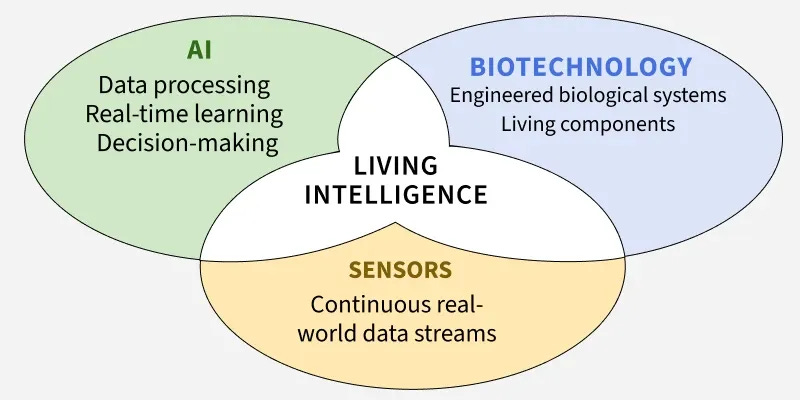
Component
Role in Living Intelligence
AI / Machine Learning
Acts as the decision-making / pattern recognition engine. Learns from sensor data, adapts behavior, and can even generate new designs or decisions independently.
Sensors
The “sensory organs.” Biosensors, environmental sensors, wearable sensors etc. continuously feed real-world, biological or physical data into the system.
Biotechnology
Provides the biological side: engineered cells or tissues, genetic components, bio-interfaces, synthetic biology etc. It enables systems to act directly on living or biological materials, not just passively observe.
These work in a feedback loop: Sensors = AI analyses = Biotech-enabled action or adaptation = new sensors feedback – these are trained to enabling dynamic, continuous adaptation. Other technical enablers include edge computing (making decisions close to where data is collected), miniaturization of sensors, and biocompatible electronics.
Applications & Use Cases
The concept is still emerging, but many sectors are already cited as early or near-future beneficiaries:
Sector
Examples
Healthcare & Medicine
Wearables / implants that monitor internal biomarkers; smart prosthetics that respond to neural signals; personalized therapies that adjust based on biomarker feedback.
Agriculture & Food Systems
Sensor-driven precision farming; bioengineered plants or microbes that respond to environmental signals as managed by AI; optimizing nutrient flows etc.
Environmental Monitoring / Sustainability
Biosensors to detect pollutants or ecosystem stress; AI-driven responses (remediation); climate-oriented sensor networks.
Smart Infrastructure / Cities
Buildings or systems that adjust dynamically to environment or occupant’s health; energy/distribution systems that self-adjust based on usage, environmental factors.
Human Augmentation / Interfaces
Brain-computer interfaces, neural implants, smart prosthetics that use living or semi-living components or advanced feedback loops.
New Intelligence in Healthcare
We are entering a new era of “living intelligence,” where AI is advancing economic sectors, technology, and scientific breakthroughs and enhancing daily life, often without our awareness, according to the Future Today Institute’s latest report, The Era of Living Intelligence. Navigating the technology supercycle powering the next wave of innovation.
The report introduces the concept of “living intelligence,” which combines artificial intelligence, ubiquitous data-collecting sensors (such as those in smartphones and smartwatches), and bioengineering. This convergence promises rapid advancements in fields historically constrained by data access and analysis capabilities, particularly in scientific research and healthcare.
In January 2025, the launch of Project Digits, an NVIDIA supercomputer about the size of a box that fits in the palm of your hand, offers hope for further global advancements in AI. Despite its small size, it is approximately 1,000 times more powerful than standard laptops and costs only $3,000. This leap in computing power, which was previously a major obstacle to applying AI to large-scale scientific research, is now accessible to smaller research centers due to its affordability.
AI is poised to address some of pharma’s biggest challenges, such as the high cost, long timelines, and a failure rate of nearly 80% in drug development. New solutions are improving hit identification by predicting drug-target interactions, thus saving time and reducing experimental validation costs. The advent of generative AI in 2023 introduced generative antibody design alongside in-silico clinical trials using human digital twins. Early results show that AI-powered digital twins can predict the outcomes of phase 3 clinical trials with impressive accuracy, accelerating the development of AI-designed chemical molecules.
https://www.icthealth.org/news/advances-in-ai-for-life-sciences-to-be-expected-in-2025
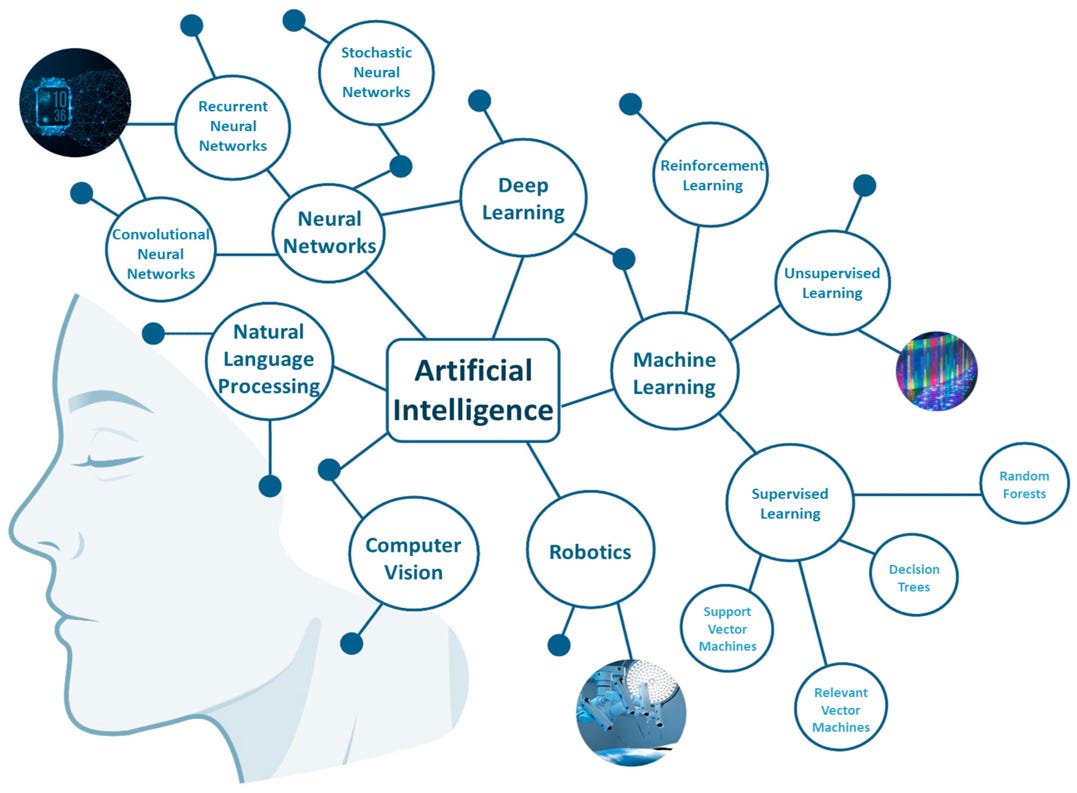
Artificial Intelligence: The Milestone in Modern Biomedical Research
In recent years, the advent of new experimental methodologies for studying the high complexity of the human genome and proteome has led to the generation of an increasing amount of digital information, hence bioinformatics, which harnesses computer science, biology, and chemistry, playing a mandatory role for the analysis of the produced datasets. The emerging technology of Artificial Intelligence (AI), including Machine Learning (ML) and Artificial Neural Networks (ANNs), is nowadays at the core of biomedical research and has already paved the way for significant breakthroughs in both biological and medical sciences. AI and computer science have transformed traditional medicine into modern biomedicine, thus promising a new era in systems biology that will enhance drug discovery strategies and facilitate clinical practice. The current review defines the main categories of AI and thoroughly describes the fundamental principles of the widely used ML, ANNs and DL approaches. Furthermore, we aim to underline the determinant role of AI-based methods in various biological research fields, such as proteomics and drug design techniques, and finally, investigate the implication of AI in everyday clinical practice and healthcare systems. Finally, this review also highlights the challenges and future directions of AI in Modern Biomedical study.
Highly alarming and well documented information, wake-up and resistance call to action. Thanks for sharing! See also: https://falkentheater.substack.com/p/the-dragons-breath-geo-engineering
100% you are 🎯