One Health

What is the National One Health Framework to Address Zoonotic Diseases and Advance Public Health Preparedness in the United States (NOHF-Zoonoses). Created, managed, and facilitated within the Center for Disease Control and Prevention.
One Health is a collaborative, multisectoral, and transdisciplinary approach - working at the local, regional, national, and global levels - with the goal of achieving optimal health outcomes recognizing the interconnection between people, animals, plants, and their shared environment. (U.S. Government Definition, established 2017).
The concept of One Health to create equality status among ALL species in regard to viruses, pathogens, diseases and illnesses; and to create a cohesive One Health ecosystem which is maintained by several government entities: HHS, FDA, Dept. of Agriculture, Dept. pf Interior, Dept. of Homeland Security, Department of Energy to name a few.
What is One Health?
One Health is an approach that recognizes that the health of people is closely connected to the health of animals and our shared environment. One Health is not new, but it has become more important in recent years. This is because many factors have changed interactions between people, animals, plants, and our environment.
Human populations are growing and expanding into new geographic areas. As a result, more people live in close contact with wild and domestic animals, both livestock and pets. Animals play an important role in our lives, whether for food, fiber, livelihoods, travel, sport, education, or companionship. Close contact with animals and their environments provides more opportunities for diseases to pass between animals and people.
The earth has experienced changes in climate and land use, such as deforestation and intensive farming practices. Disruptions in environmental conditions and habitats can provide new opportunities for diseases to pass to animals.
The movement of people, animals, and animal products has increased from international travel and trade. As a result, diseases can spread quickly across borders and around the globe.
These changes have led to the spread of existing or known (endemic) and new or emerging zoonotic diseases, which are diseases that can spread between animals and people. Every year, millions of people and animals around the world are affected by zoonotic diseases. Examples of zoonotic diseases include:
Rabies, Salmonella infection, West Nile virus infection, Q Fever (Coxiella burnetii), Anthrax, Brucellosis, Lyme disease, Ringworm, Ebola
Similar to humans, animals are also at risk of getting sick from some diseases and environmental hazards. Because of this, they can sometimes serve as early warning signs of potential human illness.
https://www.cdc.gov/one-health/about/index.html
CDC - One Health Fact Sheet
https://www.cdc.gov/one-health/media/pdfs/OneHealth-FactSheet-FINAL.pdf
Federal One Health Coordination
CDC works closely with the US Department of Agriculture (USDA), the Department of the Interior (DOI), and many other federal agencies to exchange information and coordinate One Health activities across the United States government.
The NOHF-Zoonoses will guide collaborative efforts across the United States government for the next 5 years, helping federal agencies work together to prevent and control zoonotic diseases and prepare for future health threats, protecting health for all.
Advancing One Health in the United States
The first ever National One Health Framework to Address Zoonotic Diseases and Advance Public Health Preparedness in the United States includes a common vision, mission, and goals for key federal partners involved in implementing the One Health approach to protect people, animals, and our shared environment from zoonotic diseases and other One Health threats.
National One Health Framework to Address Zoonotic Diseases and Advance Public Health Preparedness in the U.S.
In both the 2021 House Appropriations Committee Report and the 2023 Consolidated Appropriations Act, Congress directed CDC to collaborate with USDA, DOI, and other federal agencies partners to create a National One Health Framework to Address Zoonotic Diseases and Advance Public Health Preparedness in the United States (NOHF-Zoonoses).
The NOHF-Zoonoses will inform One Health collaboration across the U.S. government for the next 5 years, describing a common vision, mission, and goals for key federal partners involved in implementing the One Health approach to protect people, animals, and our shared environment from zoonotic diseases and other One Health threats within the United States.
The framework establishes goals and objectives to strengthen coordinated federal activities in the United States and better prepare for the next potential threat.
U.S. One Health Coordination Unit
The Act also directed CDC to collaborate with interagency partners on the development of a One Health coordination mechanism at the federal level to strengthen One Health collaboration related to prevention, detection, control, and response for zoonotic diseases and related One Health work across the federal government. As a result of this directive, the U.S. One Health Coordination Unit (U.S. OHCU) was launched in January 2024. The U.S. OHCU is built on shared interagency leadership from CDC, Department of the Interior (DOI) and U.S. Department of Agriculture (USDA) and brings together 24 agencies to enhance collaboration that benefits human, animal, plants and environment health through activities such as promoting health, enhancing health-sustaining resources, emergency preparedness, and the prevention, detection, and response to zoonotic diseases.
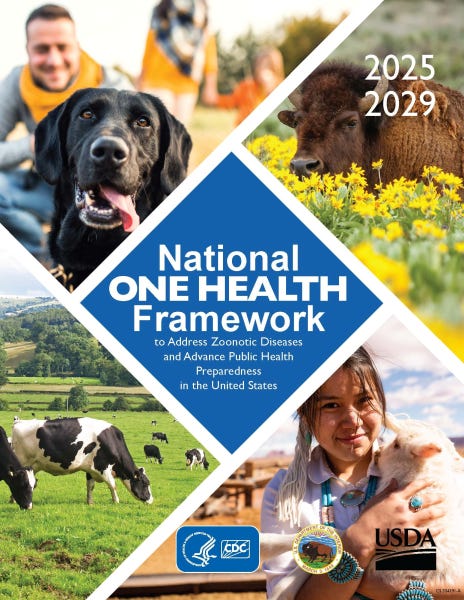
National One Health Framework to Address Zoonotic Diseases and Advance Public Health Preparedness in the United States (link above)
Executive Summary
The first ever (NOHF-Zoonoses), 2025-2029, establishes a structure to facilitate multisectoral and transdisciplinary coordination, collaboration, and communication across the federal government. Using the One Health approach, the framework addresses zoonotic diseases and other priority One Health issues in the United States (U.S.). The One Health approach recognizes the interdependence of the health of humans, domestic and wild animals, plants, and the wider environment (including ecosystems). This approach mobilizes multiple sectors, disciplines, and communities to work together to promote well-being and address health and ecosystem threats.
Previous multisectoral work in the U.S. identified the critical need to formalize federal One Health coordination to address zoonotic diseases and other One Health related issues across the U.S. Government. Therefore, in the 2023 Consolidated Appropriations Act and the 2021 House Appropriations Committee Report, Congress directed the Centers for Disease Control and Prevention (CDC) in coordination with other federal agencies, to develop a framework based on the One Health approach to address zoonotic diseases and advance public health preparedness. The Act also directed CDC to coordinate with the U.S. Department of Agriculture (USDA) and the Department of the Interior (DOI) to develop a mechanism to support coordination at the federal level related to prevention, detection, control, and response for zoonotic diseases and related One Health activities.
The One Health approach applies to zoonotic diseases as well as many other health threats at the interconnection between people, animals, plants, and the environment. While the primary focus of the NOHF-Zoonoses is addressing zoonotic diseases and advancing public health preparedness, the U.S. OHCU has also incorporated other components of One Health into this framework.
To meet these directives CDC partnered with DOI, USDA and other federal agencies beginning in November 2021,
to plan the establishment of the United States One Health Coordination Unit (U.S. OHCU) and to draft the NOHF- Zoonoses. The U.S. OHCU was launched in January 2024, with joint leadership from CDC (Chair 2024-2026), DOI, and USDA. The U.S. OHCU is coordinated by a Chair that will rotate between CDC, USDA, and DOI on a biennial calendar year basis. U.S. OHCU membership includes 24 agencies related to health, agriculture, interior, wildlife, environment, development, state, commerce, defense, security, and other fields. The draft NOHF-Zoonoses was published in September 2023 via the Federal Register Notice process, to engage and obtain input from state, Tribe, local, and territorial (STLT), non-governmental partners, and the public.
The NOHF-Zoonoses presents goals and objectives for application of the One Health approach to protect people, animals, and our shared environment in the U.S. from zoonotic diseases and advance public health preparedness to optimize health, food safety and security, and sustainability while also promoting biodiversity and conservation outcomes. The NOHF-Zoonoses was designed to align with and complement existing U.S. initiatives that incorporate the One Health approach. The seven goals outlined in the NOHF-Zoonoses include the following areas: (1) Coordination, Collaboration and Communication; (2) Prevention; (3) Preparedness; (4) Coordinated Outbreak Investigation, Response, and Recovery; (5) Surveillance; (6) Laboratory; and (7) Workforce.
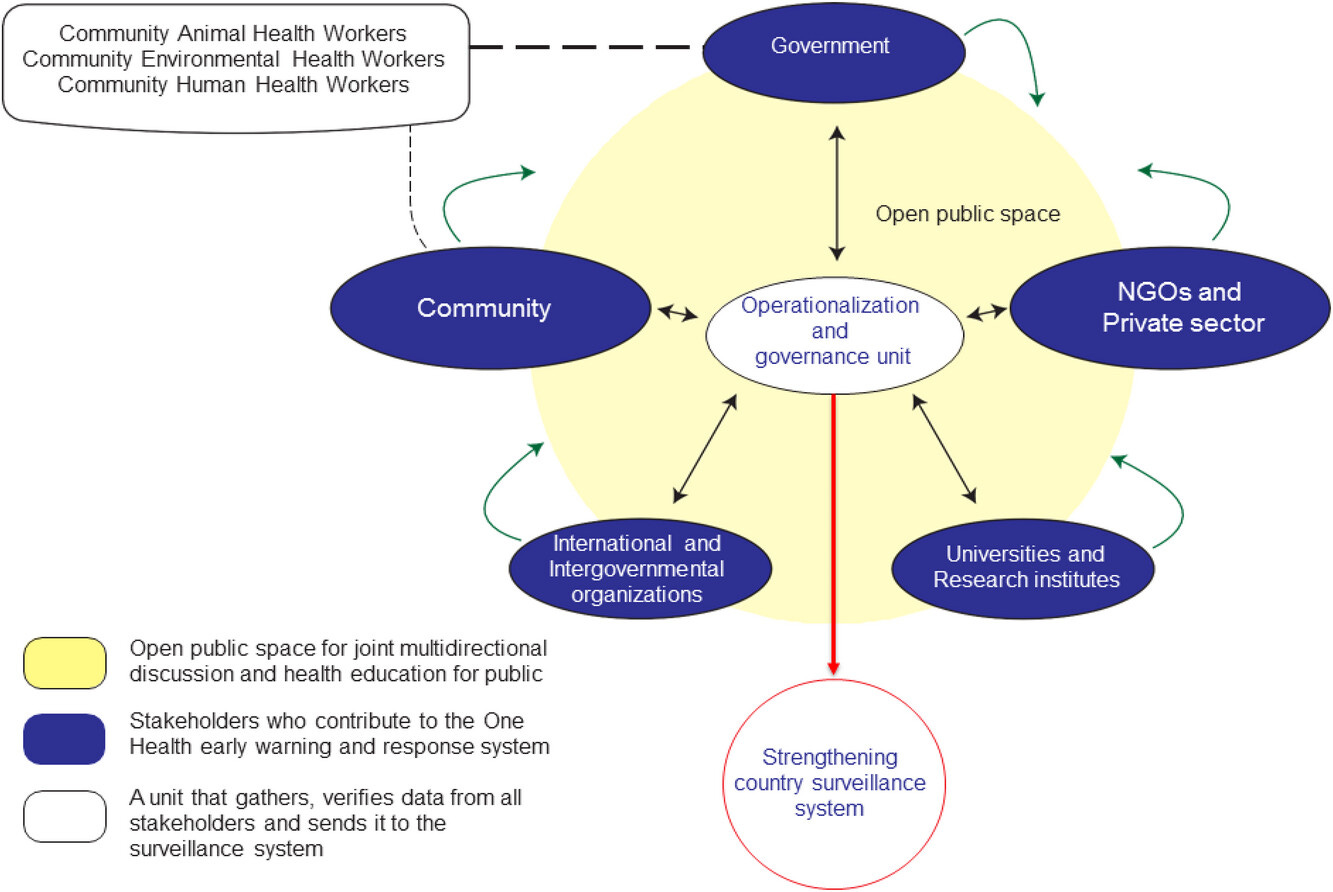
While this framework focuses on One Health coordination at the federal level, its success depends on robust partnerships with STLT, non-governmental organizations, academia, and private sector partners as well as collaboration with relevant international partners. Knowledge and best practices from the implementation of the NOHF-Zoonoses will inform future One Health priorities and strengthen the nation’s ability to address One Health threats and promote health, safety, security, and resilience at the human-animal-plant-environment interface.